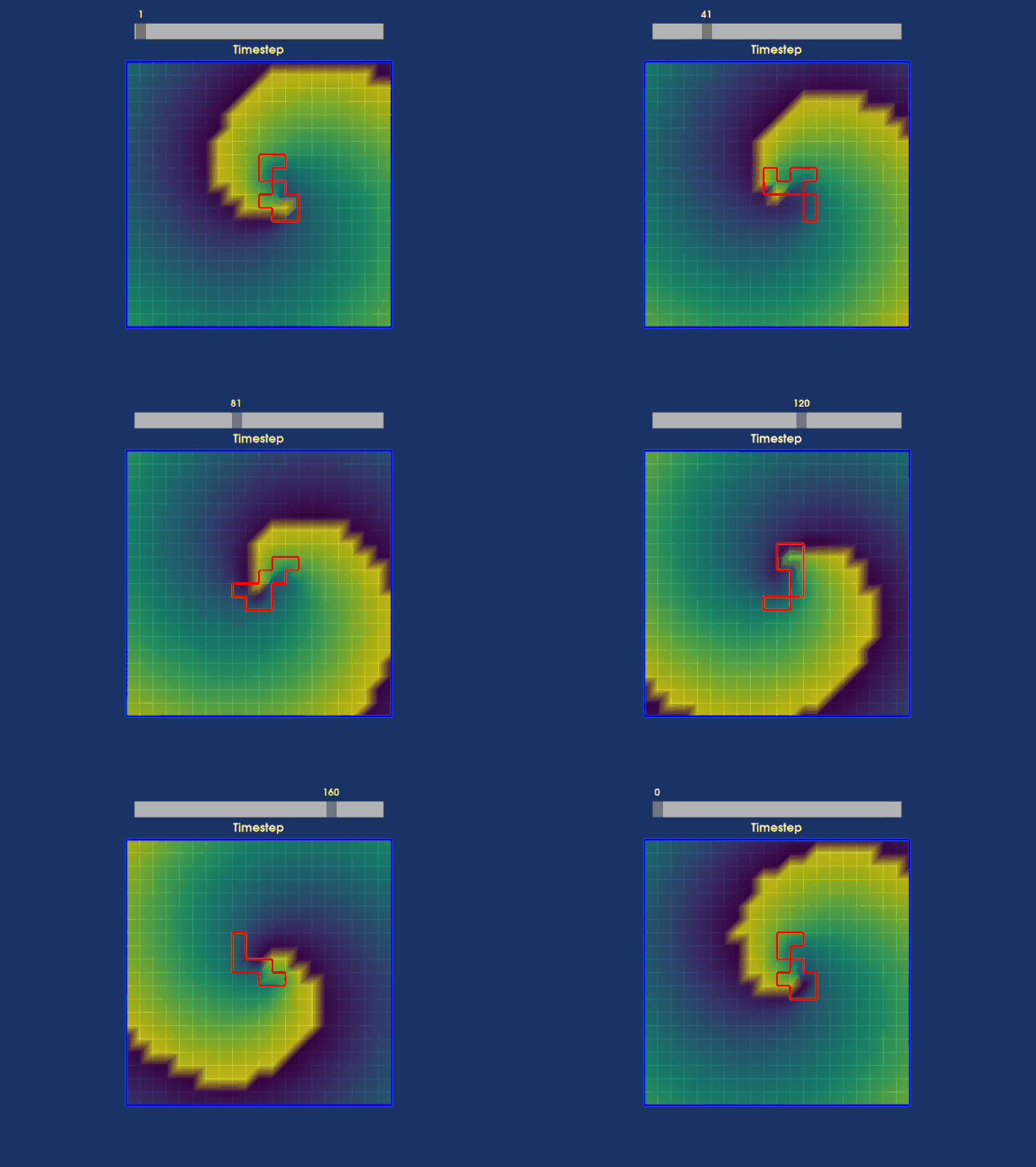
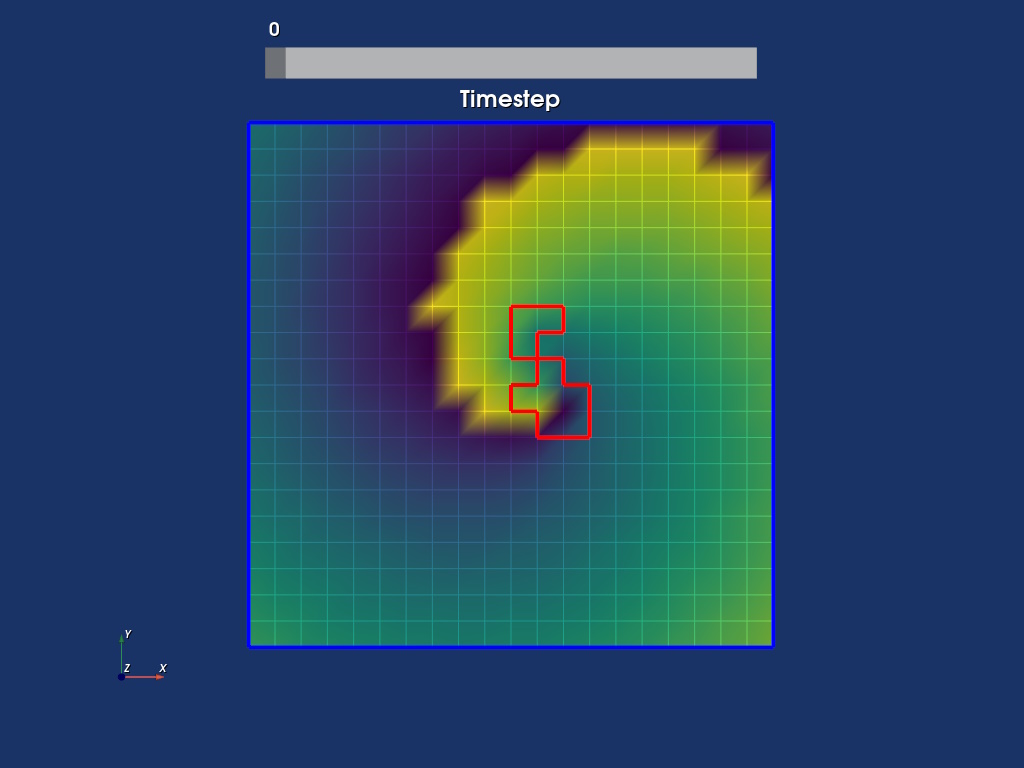
OpenDGM

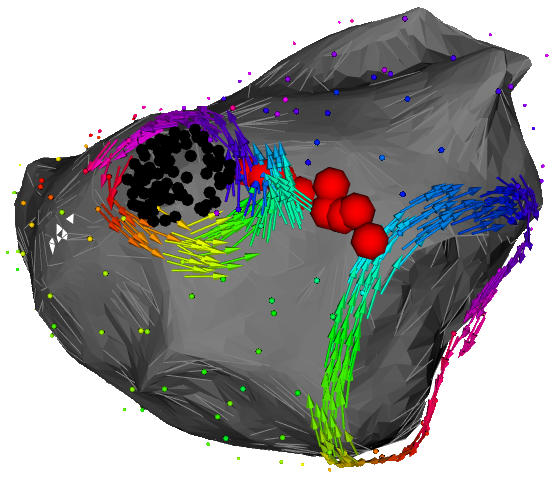
A diagnostic software framework to - automatically - determine the source of a given arrhythmia. Using network theory on cardiac excitation, OpenDGM is capable of detecting all critical boundaries, to allow the optimal ablation line in each case.
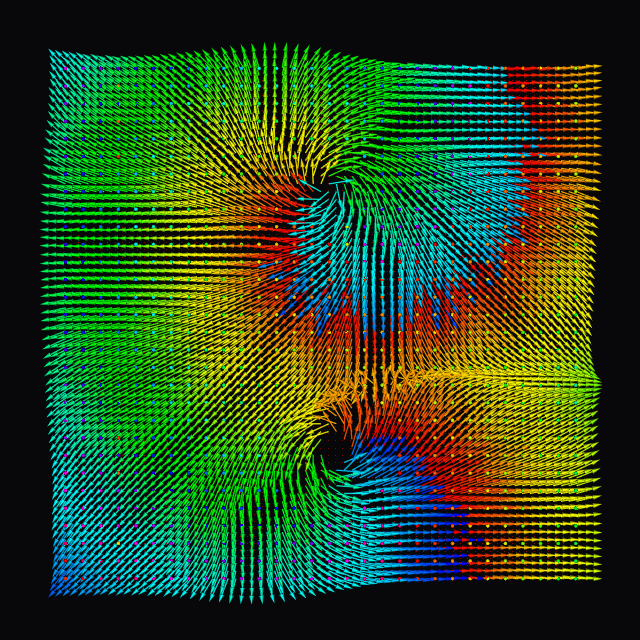
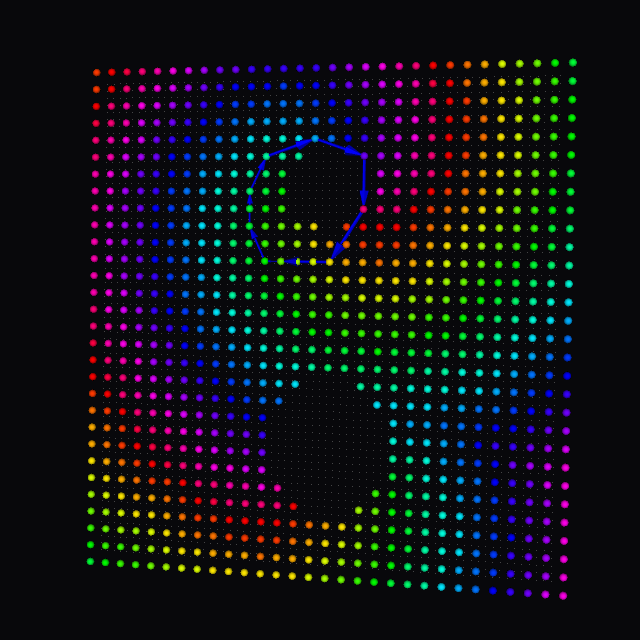
Open source

OpenDGM is actively maintained and new features are added regularly. It is open source and free to use under the GPLv3. GNU GENERAL PUBLIC LICENSE version 3.

Intuitive

Each core object - mesh, graph, cycles, ... - has its own wrapper class for quick access, manipulation and visualization.

Modular

Our modular approach makes it easy to swap different parts in your pipeline to test different setups. The in- and output of a module stays the same. What happens in between is up to you!

Scalable

Modules make it easily scalable. Run and compare multiple cases or run your algorithms over a whole parameter space.

Modules

Parser

Parsing of electrophysiological mapping data. We support the following mapping systems and simulation software:

CARTO, Rhythmia, MonoAlg3D, OpenCARP, OpenEP

Signal

Processing of signal data. Multiple filters are implemented as well as different ways to annotate signals and extract local activation times.

Graph

Creation and processing of graphs. Includes methods to merge multiple graphs as well as filters to remove unwanted edges.

Topo

Topology bases objects and processing toolkit to manipulate those objects. These objects together with Graph form the basis for in- and output of our other modules.

.

Algorithm

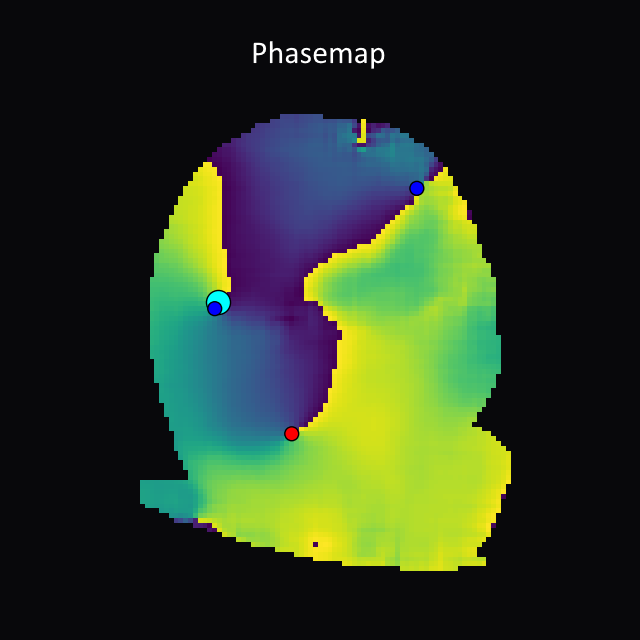
Algorithms to detect phase singularities, reentry cycles, focal sources, (critical) boundaries.

Using topology, phasemapping, helmholtz, cycle search and others.

plot.py A lightweight PyVista wrapper for easy visualization, including animations, time series and widget functionality.

Get started

Visit our code repository and get started now!

git clone https://gitlab.com/opendgm/opendgm.git
cd opendgm
pip install .

Show / Hide text

Let's see how it works! The visualization of each step is shown below.

We start by importing the needed modules and load some data.

import numpy as np
from opendgm.topo import Mesh, SklClustering
from opendgm.graph import Graph, CvFilter, DeltaLatFilter
from opendgm.algorithm import CycleSearch
Data parsing

! Parsers are available for major mapping systems and simulation software such as CARTO, Rhythmia and OpenCARP.

points = np.loadtxt(root / "points.txt")
triangles = np.loadtxt(root / "elements.txt").astype(int)
scalars = np.loadtxt(root / "scalars.txt")
Mesh topology

We construct a Mesh object and sample points at a regular distance of 4.

# Sample mesh nodes
mesh = Mesh.from_arrays(points, triangles, scalars)
sample_nodes = mesh.sample(r=4)
Graph

With these sampled points, we construct a Graph. Connections are filtered out based on edge length, conduction velocity and difference in local activation times.

# Construct graph
graph = Graph(sample_nodes.coords, sample_nodes.scalars, max_edge_length=13)
graph.filter(CvFilter(cv_min=0.01, cv_max=5))
graph.filter(DeltaLatFilter(dt_max=100))
Algorithm · Cycle Search

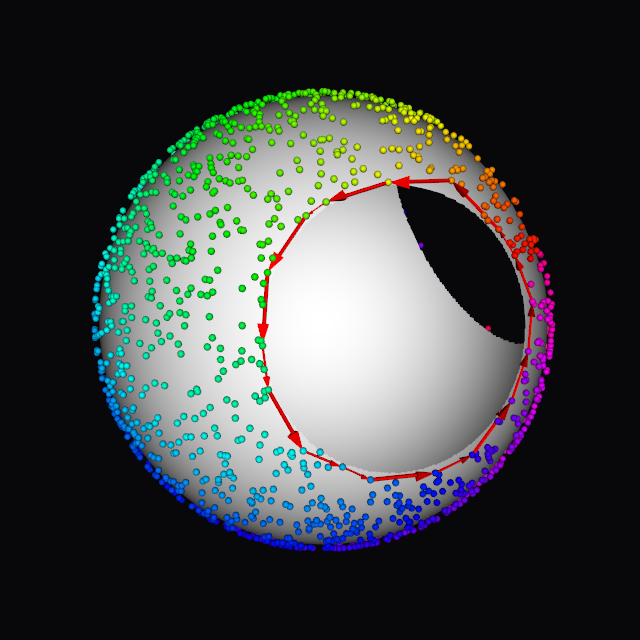
Using the Dijkstra shortest path algorithm, we search our graph for cycles.

The resulting cycles are then clustered using SklClustering, based on the normal of each cycle.

We extract the shortes cycle of each cluster using standard pandas dataframe methods.

# Search for cycles
graph.search(CycleSearch(algorithm="dijkstra", search="shortest"))

# Cluster based on normal of each cycle
cycles = graph.cycles
cycles.cluster(SklClustering("normal"))

# Cycle with shortest length from each cluster
clusters = cycles.df.groupby("cluster")
min_idx = clusters["cycle_length"].idxmin()
Bonus

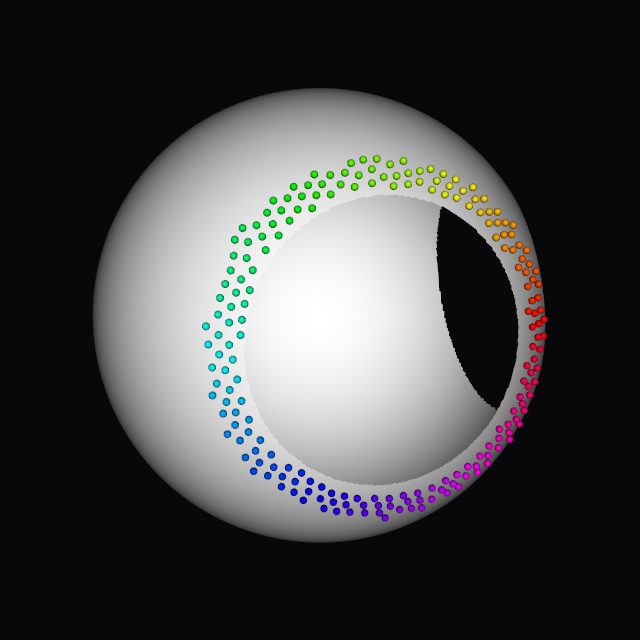
As a bonus, we create an animation of the wave on our mesh.

We permute our scalars one unit for the duration of our period and use these to create a new Mesh object.

period = 260
scalars_2d = (scalars[None, :] + np.arange(period)[:, None]) % period
mesh_4d = Mesh.from_arrays(points, triangles, scalars_2d)

plot = Plot(800, 600)
plot.add_mesh(mesh_4d, cmap="hsv")
plot.animate(fps=60, slider=False)
Wave animation
Full graph
Cycle clusters
Shortest per cluster

The full example above - including all visualizations - can be found at examples/get_started.py in our repository!

For more examples on the use of each module, please check the examples folder of our repository.

Contact us

We'd like to hear from you! If you are interested in using OpenDGM, in collaborating with us or want to provide us with valuable feedback, simply send us an email and we will contact you as soon as possible.

For research collaborations
nele.vandersickel@ugent.be

Software-related
sander.hendrickx@ugent.be